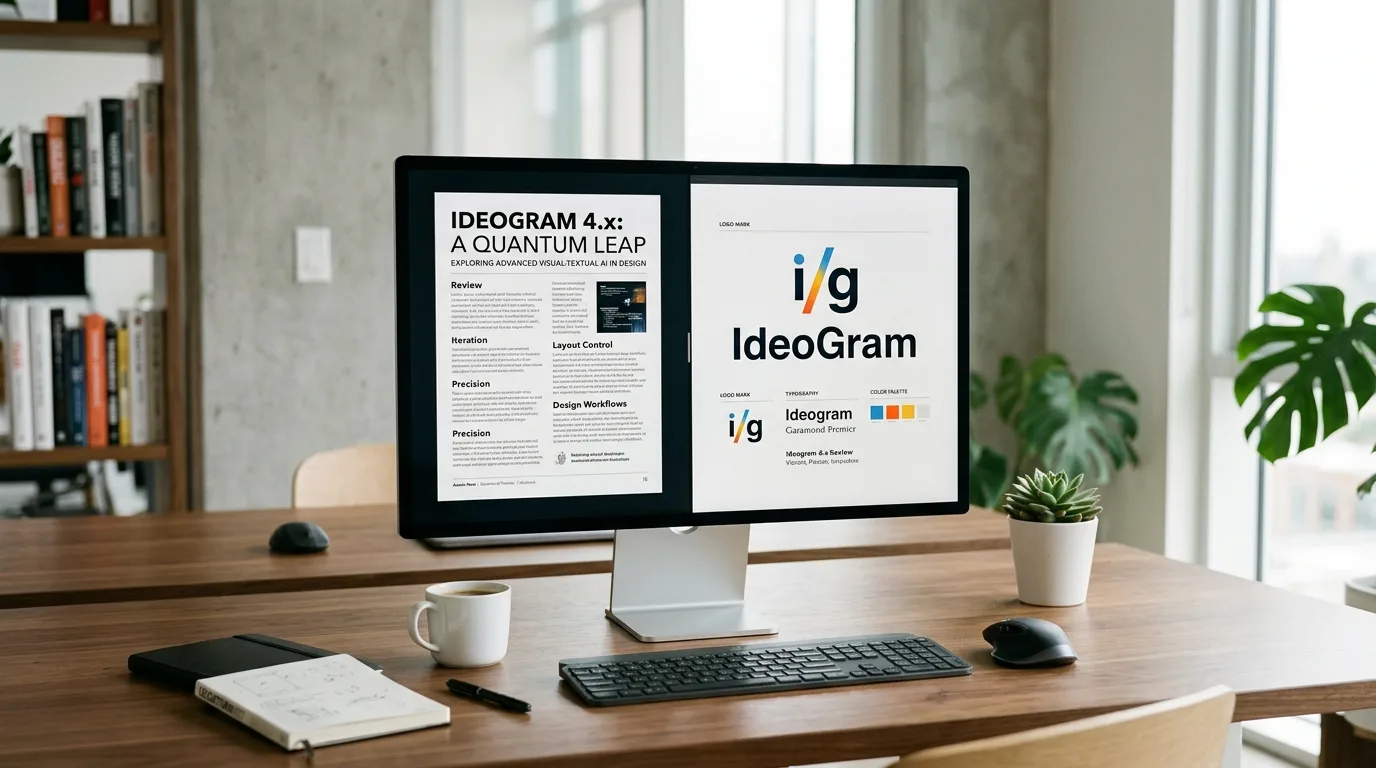
Key Takeaways
Ideogram remains the specialist to reach for when legible, correctly placed text is non-negotiable. In late 2026, Ideogram 4.5 (and the 4.x line) still leads or matches the best alternatives on pure typography reliability for posters, logos, labels, and multi-line layouts.
It is particularly strong at dense text, mixed font weights, multi-line hierarchy, and design-oriented compositions where the words are the primary content rather than decoration.
Transparent backgrounds and clean cutouts are practical for design workflows. Vector output options expand its usefulness for logo and brand system work.
Free tier exists but images are public. Paid plans (Plus from $20/month or $15 billed yearly) unlock private generation and usable monthly credit volume for regular text-heavy work.
For marketers, designers, and product teams who ship text-in-image assets weekly, Ideogram is still one of the highest-leverage tools in the stack.
Most general-purpose image models have improved dramatically at rendering short text. Few have matched Ideogram’s consistency on the harder cases: multi-line posters, packaging labels with exact wording, logo treatments, event graphics, and any layout where the words must be correct, well-placed, and visually integrated. In 2026 that specialization still defines the product.
This article focuses on practical use for text-heavy design work — what Ideogram 4.x actually delivers in day-to-day poster, logo, and layout tasks, how the pricing works, and when it is still the better first choice over GPT Image 2.5 or other generalists. For the wider ranking, see our comparison of the best AI image generators of 2026.
Why Text Still Matters
Many teams discovered in 2024–2025 that “good enough” text from general models still required cleanup in Photoshop or Figma. The gap has narrowed, but the cost of a single misspelled headline or a broken layout on a client deliverable remains high. Ideogram’s value proposition is simple: reduce the number of times you have to fix the words after generation. For anyone who ships posters, social graphics with copy, packaging concepts, or brand mockups, that reduction compounds quickly.
What Ideogram 4.x Does Best
Typography Reliability
Short headlines are now handled well by several models. Dense multi-line text, mixed weights, precise placement, and hierarchical layouts (headline + subhead + body + small print) remain Ideogram’s core strength. Independent tests and production experience continue to show higher first-pass success rates on complex text compositions than most generalists. When the brief is “make a poster where every word is correct and properly arranged,” Ideogram is still the model many designers open first.
Design-Oriented Composition
Ideogram tends to treat text as a primary design element rather than an afterthought. Layouts often feel closer to something a graphic designer would produce: balanced negative space, intentional hierarchy, and integration between type and imagery. This is especially noticeable on posters, event graphics, and packaging concepts.
Transparent Backgrounds and Cutouts
Native support for transparent backgrounds and clean cutouts is practical for design systems. Assets that need to drop onto different backgrounds or be used as overlays benefit from this. Combined with strong text, it makes Ideogram useful for logo explorations, sticker concepts, and modular brand assets.
Vector and Brand-Adjacent Work
Ideogram’s vector-oriented capabilities (where available in the current lineup) extend its usefulness beyond raster posters into logo and identity exploration. Results still require human refinement for final brand use, but the starting points are often closer to usable design assets than pure photoreal models produce.
Where It Is Less Dominant
Pure Photorealism and Cinematic Atmosphere
Ideogram is competent at photoreal scenes, but it is not the leader. Nano Banana and FLUX frequently produce more natural photographic results; Midjourney and Grok Imagine often deliver stronger cinematic mood. When the brief is primarily about photography or atmosphere and text is secondary or absent, other models are usually better first choices.
Complex Multi-Constraint Scene Control
GPT Image 2.5 remains stronger at absorbing long, multi-part prompts that mix precise composition, lighting, product placement, and style references in a single generation. Ideogram shines when text and layout are the priority; it is less dominant when the image is a complex photographic scene that happens to contain some text.
Pricing and Plans
Plan | Monthly (approx.) | Credits | Key Notes |
|---|---|---|---|
Free | $0 | ~30 / week | Images are public |
Plus | $20 ($15 yearly) | 2,400 / month | Private generation; practical for regular text-heavy work |
Pro | $60 ($42 yearly) | 7,500 / month | Higher volume, batch options |
Team | $30 / user | 3,600 / user | Multi-user; private |
Credit consumption varies by quality setting and whether source images are used. Medium quality on current 4.5 models typically costs around 6 credits per image; higher settings and reference-heavy edits cost more. Plus is the practical entry point for anyone generating text-heavy assets more than occasionally. Free-tier images being public is an important constraint for client or brand work.
Practical rule of thumb: If you regularly produce posters, packaging concepts, event graphics, or any asset where the words must be correct, Plus (or higher) is usually justified. The reduction in post-generation text fixes often pays for the subscription in saved design time.

Prompting Notes for Text Work
Put the exact words you need in quotes. Specify hierarchy and placement when it matters (“large bold headline centered at the top, smaller subhead below it, small footer text at the bottom”). Ideogram responds well to design-language prompts that describe layout structure rather than pure scene description. For logos and wordmarks, iterate with clear constraints on style, weight, and negative space. Transparent background requests should be explicit when the asset needs to be composited later.
For complex multi-line posters, generating a few variations at medium quality and then refining the strongest candidate is often more efficient than chasing a single perfect first generation at the highest setting.
When to Choose Ideogram
Make it the primary tool when:
The image is text-primary: posters, packaging, event graphics, menus, labels, social graphics with headlines
You need reliable multi-line hierarchy and correct spelling on first or second pass
Transparent backgrounds or design-system assets are required
You are exploring logo or wordmark directions
Reach for another model when:
Pure photorealism or cinematic atmosphere is the main goal → Nano Banana, FLUX, or Grok Imagine
Complex multi-constraint photographic scenes with secondary text → GPT Image 2.5
Distinctive artistic style and mood → Midjourney V8.2
Native vector brand systems at scale → Recraft
Bottom Line
Ideogram 4.x remains the specialist tool for text-heavy design work in 2026. General models have closed much of the gap on short text, but the combination of typography reliability, design-oriented composition, transparent backgrounds, and practical credit pricing still makes Ideogram the highest-leverage choice for posters, packaging concepts, logos, and any asset where the words must be right.
It does not replace a generalist. It complements one. Keep GPT Image 2.5 or Nano Banana for broad creative work and reach for Ideogram when the brief is fundamentally about type and layout. That division of labor continues to save time and reduce frustration on the projects that actually ship.
Explore the Full Cluster
Deep dives, real-project notes, and practical prompt systems for every major model in the 2026 ranking.
GPT Image 2.5 Deep Dive: How Good Is OpenAI’s Current Image Model in Real Use?
Google’s Nano Banana Series Tested: Speed, Consistency, and Value in 2026
Midjourney V8.2 After Months of Daily Use: Still the Style King?
Grok Imagine Image 2.0: Cinematic Results and Where It Actually Shines
Seedream 5 in Practice: Commercial and Design Work Outside the Usual Suspects
Recraft for Brand Work: Vectors, Consistency, and Design Systems
Prompts That Actually Work Across GPT Image, Nano Banana, Midjourney & FLUX
What I Learned Running These Models for Real Projects All Year
For AI tool features, rules and availability, refer to their official sites.
Leave your thoughts here, too.