
Key Takeaways
Summarization creates the feeling of progress while often producing only shallow familiarity. Real learning requires retrieval, explanation, application, and correction.
AI is most useful for learning when it acts as a tutor, examiner, and practice partner—not as a permanent summarizer.
Effective patterns include: explaining concepts back in your own words, generating questions, working examples with feedback, spaced review, and deliberate difficulty.
The quality of learning prompts matters more than model version for most personal learning goals.
A simple loop—attempt, feedback, correction, re-attempt—beats passive consumption of AI-generated overviews.
The most common way people use AI for learning is also one of the weakest: they paste a chapter, an article, or a set of notes and ask for a summary. The summary arrives. It looks clean. They feel oriented. A week later, most of it is gone.
This is not a failure of the model. It is a mismatch between the tool use and how learning actually works. Summaries reduce material. Learning requires effortful processing: retrieving ideas from memory, explaining them, applying them, noticing errors, and correcting those errors. A summary can support those activities. It cannot replace them.
This final piece in the series applies the same core claim we started with—most people do not need the latest model—to personal learning. The bottleneck is rarely model power. It is whether you use AI in ways that create real cognitive work or ways that only create the sensation of having covered the material. The prompting discipline from earlier articles still applies: clarity about what you want and the four core rules make learning prompts more effective.
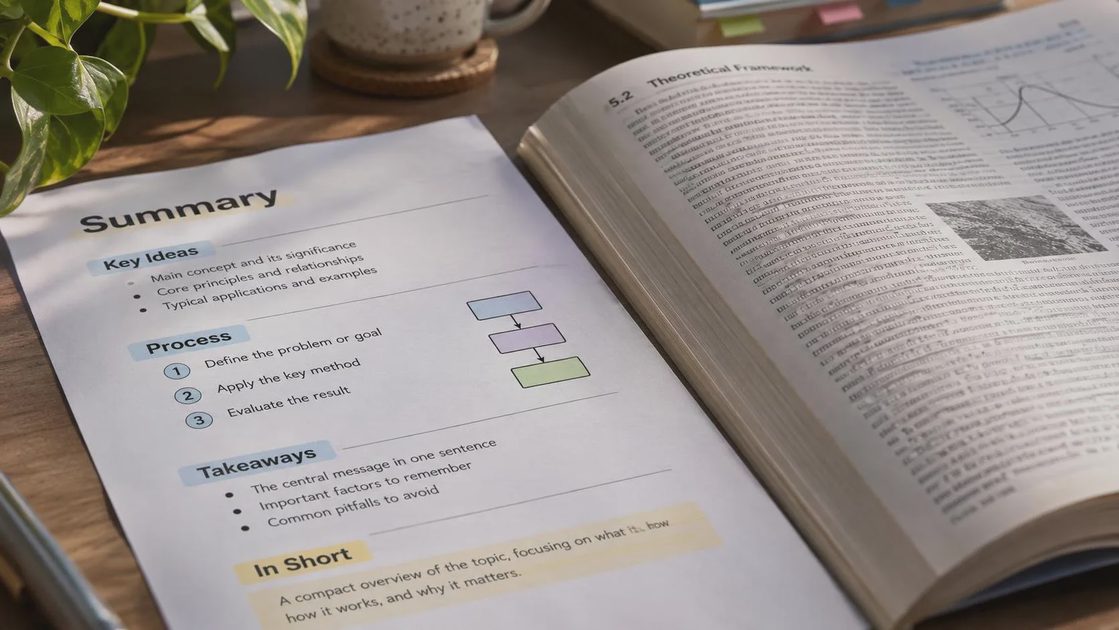
Why summaries feel useful and often are not
Summaries are attractive because they compress time and reduce intimidation. They give a map. Maps are valuable. The problem is stopping at the map.
Learning research has repeatedly shown that passive exposure produces weaker retention than active retrieval and application. When AI does the compressing for you, you skip the mental work that would have forced the material into a more durable form. You gain familiarity—“I have seen this”—without gaining ownership—“I can use this.”
Familiarity is easy to mistake for knowledge. That is why summary-heavy AI use feels productive in the moment and disappointing later.
What actual learning requires
For most practical subjects, durable learning involves some combination of:
Retrieval — recalling ideas without looking
Explanation — putting ideas into your own words
Application — using ideas on new examples
Feedback — finding out where you are wrong
Correction — fixing the specific gap and trying again
AI can support every one of these steps. The key is to design the interaction so that you do the hard part and the model helps you do it better, rather than doing the hard part for you.

Pattern 1: Explain it back (and get graded)
After reading a section or watching an explanation, close the source and explain the idea yourself. Then ask the model to evaluate the explanation.
I am trying to learn [topic]. Here is my explanation in my own words: [paste your explanation] Evaluate it as a tutor: 1. What is correct 2. What is missing or imprecise 3. One better way to phrase the core idea 4. One follow-up question that would test whether I really understand it Do not rewrite my whole explanation unless I ask.
This forces retrieval and surfaces gaps while they are still cheap to fix.
Pattern 2: Generate questions, then answer them yourself
Instead of asking for a summary, ask for questions that a competent learner should be able to answer.
I am studying [topic / source]. Generate 8 questions that test real understanding, not just definition recall. Mix: - 3 conceptual questions - 3 application questions - 2 “what would change if…” questions Do not provide answers yet.
Answer the questions yourself first. Only then ask for feedback on your answers. The sequence matters.
Pattern 3: Worked examples with deliberate practice
For skills that involve solving problems (technical topics, frameworks, analysis methods), use AI as a practice partner.
Teach me [specific skill] through practice. Process: 1. Give me one short worked example 2. Then give me a similar problem to solve myself 3. Wait for my answer 4. Tell me what is right, what is wrong, and why 5. Give one more problem at slightly higher difficulty Keep explanations concise. Focus on the decision points, not long lectures.
This is far closer to how people actually acquire usable skill than reading another overview.

Pattern 4: The “teach me as if I will have to use this tomorrow” frame
Learning improves when the goal is application, not coverage.
I need to understand [topic] well enough to [specific use: explain it in a meeting / write a short analysis / make a basic decision / implement a small version]. Teach me only what is necessary for that use. Structure: - Core idea in plain language - The 3 things I must not get wrong - One example close to my use case - One common mistake - A short self-test question Avoid encyclopedic coverage.
Scope control is a learning strategy. AI will expand to fill whatever request you give it. Ask for the minimum viable understanding for a real use, then deepen only where needed.
Pattern 5: Spaced review with AI as examiner
A week after first learning something, do not re-read the summary. Ask to be tested.
I studied [topic] last week. Quiz me. Rules: - Ask one question at a time - Wait for my answer - Give brief feedback - Increase difficulty if I am doing well - Stop after 6–8 questions and summarize the 2 weakest areas
Spaced retrieval is one of the most reliable learning methods available. AI makes it easy to run without needing a pre-built quiz bank.

Pattern 6: Contrast and boundary learning
Understanding often improves when you can say not only what something is, but what it is not, and when the rule breaks.
Help me learn the boundaries of [concept]. Explain: 1. A clear positive example 2. A near-miss example that looks similar but is different 3. The rule or distinction that separates them 4. A short question that checks whether I can apply the distinction
A full learning loop you can reuse
For any non-trivial topic, a practical loop looks like this:
Orient briefly. Ask for a short map of the topic and the 3–5 load-bearing ideas. (A summary is fine here, as long as it stays short.)
Attempt explanation. Close the source and explain one idea in your own words.
Get feedback. Ask the model to evaluate the explanation and ask one test question.
Practice. Do one application task or problem.
Correct. Fix the specific gap, not the whole topic.
Re-test later. Return after a delay and retrieve again.
This loop is slower than “summarize the chapter.” It is also the difference between temporary orientation and durable capability.
Worked example: learning a practical concept
Goal: Understand “expected value” well enough to use it in ordinary prioritization decisions at work—not to pass a probability exam.
Weak approach
Explain expected value and summarize the key formulas.
Stronger approach
I need to use expected value thinking for prioritization at work. Teach me only what I need for that. 1. Plain-language core idea 2. One work example (choosing between two projects) 3. The most common mistake people make when applying it casually 4. A self-test: give me a short scenario and ask me to reason through it Wait for my answer before explaining.
Then answer the scenario yourself. Then ask for critique. Then request one more scenario. The learning happens in the attempts, not in the initial explanation.

What to avoid
Endless summaries of material you never retrieve
Asking for “everything I need to know” with no use case
Letting the model complete practice problems for you while you watch
Collecting explanations without ever closing the tab and trying from memory
Confusing a clean notes file with actual understanding
Simple test: If you cannot explain the idea in plain language without looking, or use it on a new example, you have not learned it yet—regardless of how good the summary looked.
How this connects to the rest of the series
Across this series the recurring theme has been the same: the limiting factor for most people is not model capability. It is the quality of the request and the process around it. Learning is one more domain where that claim holds.
You do not need the newest model to learn better with AI. You need to stop outsourcing the mental work that creates learning, and instead use the model to structure, pressure-test, and give feedback on work you are willing to do yourself.
A minimal personal system
If you want something lightweight and sustainable:
Pick one topic at a time.
Write a clear use case (“good enough to do X”).
Use the explain-back + feedback pattern after each study block.
Keep a short list of missed questions and revisit them after a few days.
Save only the prompts that repeatedly produce useful practice, not every clever explanation you received.
This is compatible with a small personal prompt library. Learning prompts are some of the highest-value entries to keep.
Closing
AI can make learning faster and more interactive. It can also make it easier to stay on the surface. The difference is whether you use it to consume compressed information or to practice the skills that turn information into capability: retrieval, explanation, application, and correction.
Summaries are a starting point. They are not the work. If you want to actually learn something, design the interaction so that you still have to think.
More in this series
90% of People Don’t Need the Latest AI Model. The Real Problem Isn’t the Model
Why Most People Get More Anxious the More They Learn About AI
GPT-3.5 Is Already Enough for Most People. Here’s What I Learned Watching 100+ Regular Users
Four Core Rules for Turning Vague Ideas Into Prompts That Actually Work
How to Use AI for Decisions Without Just Asking It for the Answer
Popular AI Models in Late 2026: A Beginner-Friendly Overview
For AI tool features, rules and availability, refer to their official sites.



Leave your thoughts here, too.