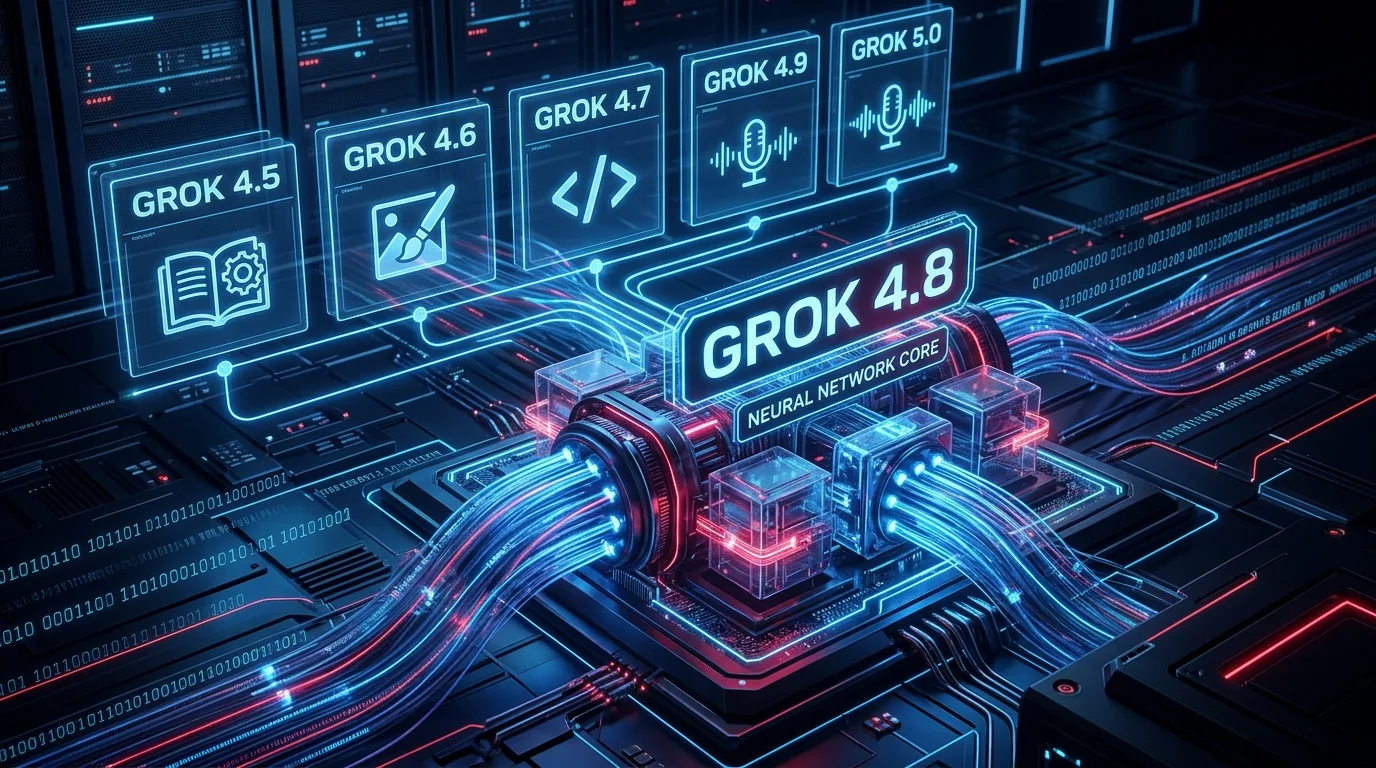
🔑 Key Takeaways
Grok 4.8 is xAI’s next major model — a 2.5-trillion-parameter system trained on a new C++ software stack. As of early November 2026 it remains unreleased, with Elon Musk confirming it has “taken longer than expected” but “will not be a disappointment.”
Focus is on real-world usefulness rather than benchmarks. Musk has explicitly stated that xAI is not optimizing for leaderboard scores; practical utility, especially for Grok Bot, is the priority.
Grok 4.7 (released September 21, 2026) is currently the strongest publicly available Grok model, offering strong coding and reasoning performance at the same price and speed as its predecessor.
Image generation via Grok Imagine continues to improve, while language capabilities emphasize truth-seeking, personality, and reduced hallucination compared with earlier versions.
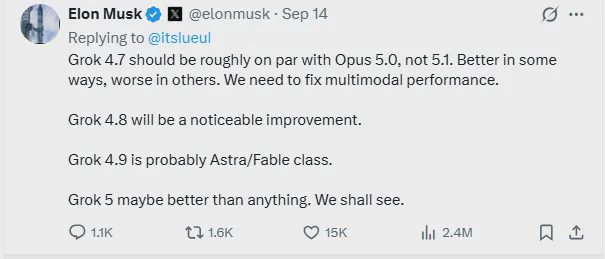
Roadmap beyond 4.8 points to Grok 4.9 (positioned as Astra/Fable-class) and Grok 5, which Musk has linked to potential AGI-level performance.
Grok 4.8: What We Know So Far
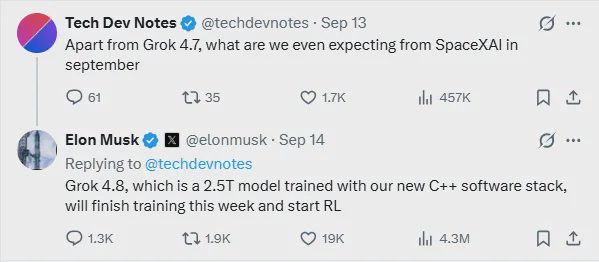
Grok 4.8 represents the next step in xAI’s rapid model iteration cycle. First publicly named by Elon Musk on September 14, 2026, the model is described as a 2.5-trillion-parameter system trained using xAI’s newly developed C++ software stack. At the time of the announcement, Musk stated that pre-training would finish that week, after which the model would enter the reinforcement learning (RL) phase.
“Grok 4.8, which is a 2.5T model trained with our new C++ software stack, will finish training this week and start RL.”
— Elon Musk, September 14, 2026
By late October, the timeline had slipped. On October 30, Musk addressed the delay directly:
“I know it’s taken longer than expected, but Grok 4.8 will not be a disappointment. We’re not optimizing for benchmarks and I really don’t care how Grok does on those, but it will be incredibly useful.”
Key positioning signals:
A “noticeable improvement” over Grok 4.7
Emphasis on practical usefulness rather than synthetic benchmark scores
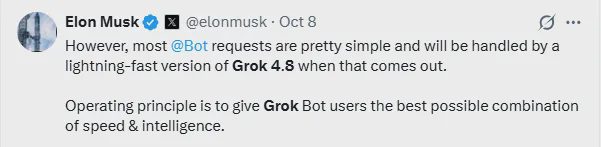
A lightning-fast variant intended to handle the majority of Grok Bot requests
Part of a longer ladder that includes Grok 4.9 and Grok 5
As of early November 2026, Grok 4.8 has not appeared on xAI’s official model list, API documentation, or news page. Grok 4.7 remains the current flagship.
Grok Model Comparison
xAI has maintained an aggressive release cadence throughout 2026. The table below summarizes the publicly discussed models in the 4.x series.
Model | Parameters (approx.) | Release Status | Notable Characteristics |
|---|---|---|---|
Grok 4.5 | ~1.5T | Released (July 2026) | Solid baseline for the 4.x generation; strong general performance |
Grok 4.6 | ~1.5T | Released (August 2026) | Improved coding and reasoning; popular among early users for conversational quality |
Grok 4.7 Current | ~2.1T | Released Sep 21, 2026 | Notable gains in coding and large-repository handling; same price/speed as 4.6 |
Grok 4.8 Upcoming | 2.5T | In RL / delayed | New C++ training stack; focus on real-world utility; fast variant for Grok Bot |
Grok 4.9 | TBD | Future | Positioned by Musk as “probably Astra/Fable class” |
Grok 5 | TBD | Future | Linked by Musk to potential AGI-level capability |
The jump from 4.7 to 4.8 is expected to be more architectural than pure scale. The introduction of a native C++ training stack suggests improvements in training efficiency, inference speed, or both—factors that matter more for production deployment than raw parameter counts.
Core Capabilities Across the Grok Lineup
Language & Reasoning
Language modeling remains the foundation of every Grok release. Users consistently highlight Grok’s distinctive personality—more direct, less overly cautious, and oriented toward truth-seeking. Later models in the 4.x series have shown progressive reductions in hallucination rates and stronger performance on complex, multi-step reasoning tasks.
Grok 4.7 in particular earned praise for handling large codebases and long-context professional workflows. Grok 4.8 is expected to extend these strengths while further refining response quality for everyday and agentic use cases.
Image Generation (Grok Imagine)
Grok Imagine has evolved into a competitive text-to-image system. Recent iterations focus on higher visual fidelity, better prompt adherence, and improved handling of complex compositions. While not always the absolute leader on every benchmark, Grok Imagine is valued for its integration within the broader Grok ecosystem and its relatively permissive generation policies compared with some competitors.
Image editing and iterative refinement capabilities continue to expand, allowing users to refine outputs through natural language follow-ups.
Coding & Software Engineering
Grok 4.7 demonstrated strong results on repository-level tasks. The upcoming 4.8 is expected to push further in agentic coding workflows, debugging, and large-scale codebase understanding.
Grok Bot & Agents
Grok Bot has become a major product surface. A dedicated fast version of Grok 4.8 is planned specifically to serve the majority of Bot requests, balancing speed and intelligence.
Voice & Multimodal
Voice models have seen rapid iteration in 2026, with significant reductions in word error rates. Multimodal understanding (vision + language) continues to improve across the lineup.
Truth-Seeking Orientation
A consistent differentiator. Later Grok models prioritize factual accuracy and reduced sycophancy over polished but potentially misleading responses.
Speed, Pricing, and Accessibility
One of xAI’s consistent strategies has been to deliver meaningful capability upgrades without corresponding price increases. Grok 4.7 launched at the same price point and latency profile as Grok 4.6. Early signals suggest Grok 4.8 will follow a similar approach, especially for the fast variant intended for high-volume Bot traffic.
Looking Ahead
Grok 4.8 sits at an interesting juncture. It is large enough to represent a clear step up from 4.7, yet xAI is deliberately framing it around usefulness rather than leaderboard dominance. This positioning may reflect a maturing view of what actually drives adoption: reliable performance on the tasks users care about day to day.
The longer development timeline also suggests that the team is prioritizing quality of the reinforcement learning phase over speed to market. In a competitive landscape where models are often released the moment they clear internal benchmarks, xAI’s willingness to let 4.8 “cook” longer is notable.
Beyond 4.8, the roadmap toward Grok 4.9 and Grok 5 indicates that xAI intends to keep climbing. Whether Grok 5 ultimately delivers the AGI-level leap Musk has referenced remains to be seen—but the intermediate steps are already shaping one of the more distinctive model families in the current generation of frontier systems.
Bottom line: Grok 4.8 is the most anticipated unreleased model in the Grok lineup. While exact timing is still unknown, the combination of scale (2.5T), a new training stack, and an explicit focus on real-world utility makes it a release worth watching closely in the coming weeks.
This article is based on publicly available statements from Elon Musk and xAI as of early November 2026. Model specifications and timelines are subject to change.
For AI tool features, rules and availability, refer to their official sites.


Leave your thoughts here, too.