Fable 5.5?
No. You were misled by the rumors. The real model that just dropped is far more interesting.
Key Takeaways
Claude Fable 5.2 (released November 9, 2026) is Anthropic’s strongest generally available model, designed specifically for long-horizon agentic work and the hardest technical challenges.
Same underlying model as Mythos 5.2. Fable adds cybersecurity and biology safeguards for public release; Mythos keeps fuller capabilities for verified organizations only.
Price dropped 20% vs Fable 5.1 ($8 input / $40 output per million tokens). Output speed improved by up to 30%. Optional Fast Mode delivers up to 2.5× speed at higher cost.
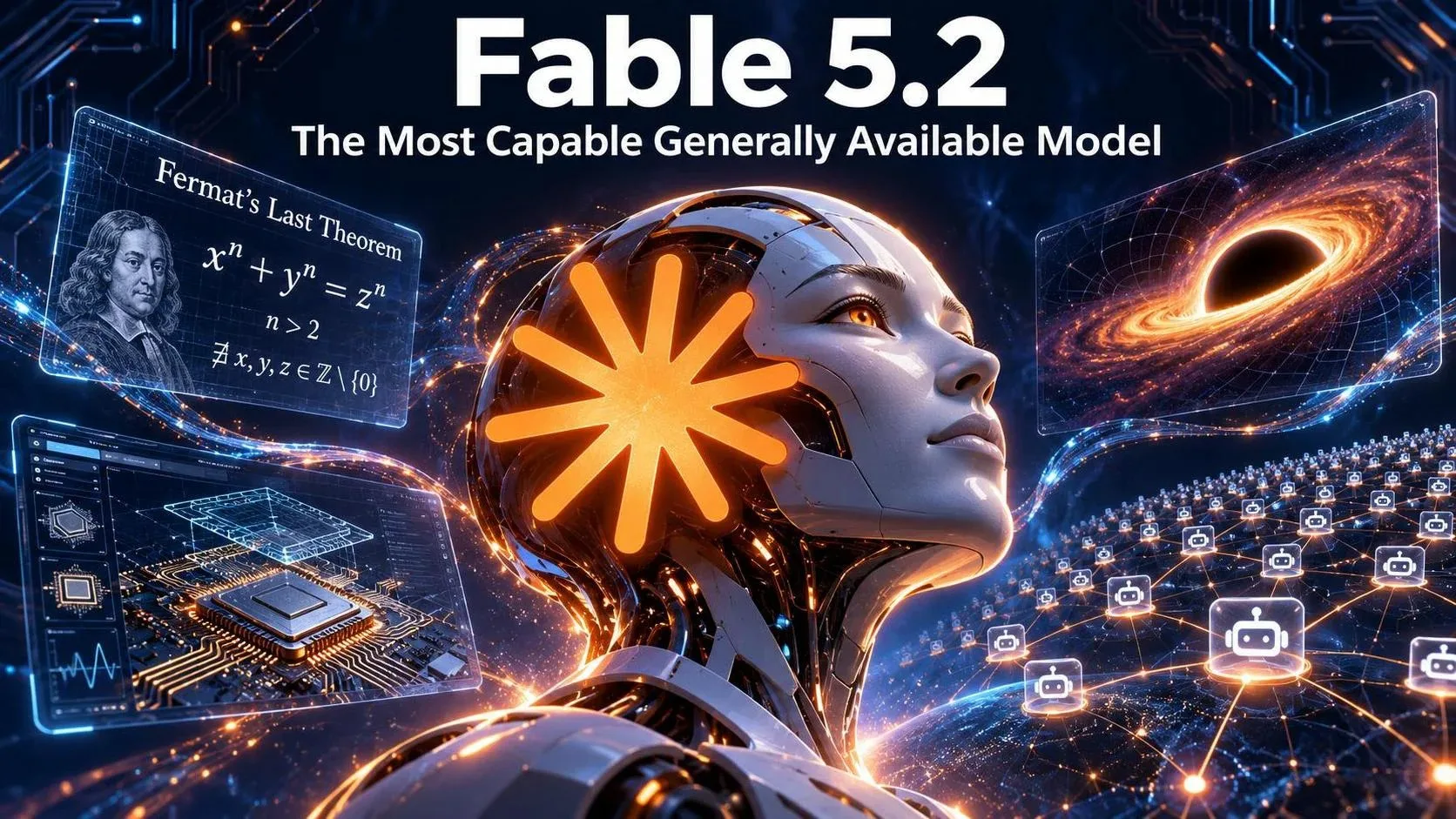
In pre-release testing, 1,000 agents formalized Fermat’s Last Theorem in ~30 hours; the model designed three working electronic devices from a short prompt; and coordinated 1,000+ sub-agents for eight days to produce a bootable operating system prototype.
It leads or ranks near the top on major agentic coding, computer-use, science, and hardware-design benchmarks, often ahead of Opus 5.5 and competing frontier models at comparable or better cost-efficiency on hard tasks.
For weeks the AI community was buzzing about “Fable 5.5.” Leaks, screenshots, and confident predictions all pointed to a November release under that name. Then November 9 arrived, and Anthropic shipped something different — and better named for what it actually is.
Claude Fable 5.2 (and its twin Mythos 5.2) is now live. It is not a minor iteration. According to Anthropic’s own framing and independent early testing, it is currently the most capable model available to the general public for demanding reasoning and long-horizon agentic work.
1. Positioning: Built for the Hardest Technical Work
Anthropic is explicit about the role of this model class. In the official announcement:
“We’ve upgraded Claude Fable and Claude Mythos — models that are designed to tackle the most daunting technical challenges.”
The company recommends starting most everyday coding and knowledge work with Claude Opus 5.5, then moving to Fable 5.2 when evaluations show that even high-effort Opus is insufficient. This is not marketing fluff — it is a deliberate product hierarchy.
Typical use cases listed by Anthropic and AWS include:
Agent sessions that run for hours or days
Multi-step deep research
Large, multi-repository software engineering
Scientific research and formal mathematical proofs
Hardware and systems design tasks
2. Dual-Model Strategy: Fable vs Mythos
Both models share the same underlying weights. The difference is in the safety layer:
Fable 5.2 — Publicly available. Adds stronger cybersecurity and biology safeguards. Blocked queries are answered by fallback models (Opus 4.8 / Opus 5).
Mythos 5.2 — Restricted to organizations verified through Anthropic’s Cyber and Life Sciences verification programs. Retains fuller capabilities in those domains.
According to Anthropic, Fable 5.2 produces approximately 55% fewer unnecessary safety blocks than Fable 5.1, making it more usable for legitimate technical work while still maintaining guardrails.
3. Core Specifications & Pricing
Specification | Fable 5.2 |
|---|---|
Context Window | 1M tokens |
Max Output | 128K tokens |
Knowledge Cutoff | June 2026 |
Input / Output Price | $8 / $40 per million tokens |
Fast Mode | $16 / $80 (up to 2.5× faster) |
Default Effort (API) | High |
Thinking | Adaptive (always on) |
Price is 20% lower than Fable 5.1 ($10 / $50). Output generation is up to 30% faster. Sources: Anthropic announcement and official model docs.
4. Benchmark Standing
Independent and vendor-reported results place Fable 5.2 at or near the top of current frontier models on agentic and technical tasks:
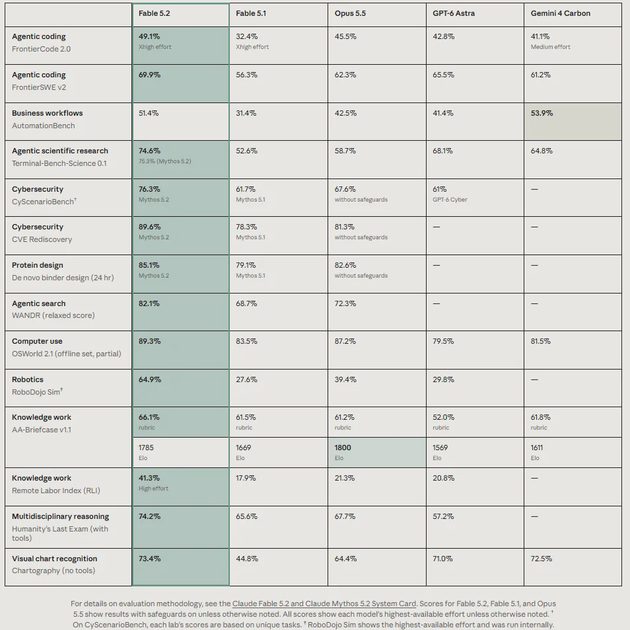
FrontierCode 2.0 (xhigh): 49.1% — ahead of Opus 5.5 (45.5%) and GPT-6 Astra (42.8%)
OSWorld 2.1 (computer use): 89.3%
Hardware design (BenchCAD / Diode PCB Gym): roughly doubled previous Fable scores (e.g., 83.5 vs 44.4 on one reported hardware-design benchmark; 69% on PCB Gym vs 25% for earlier Fable)
RoboDojo Sim: 64.9% (more than double Fable 5.1)
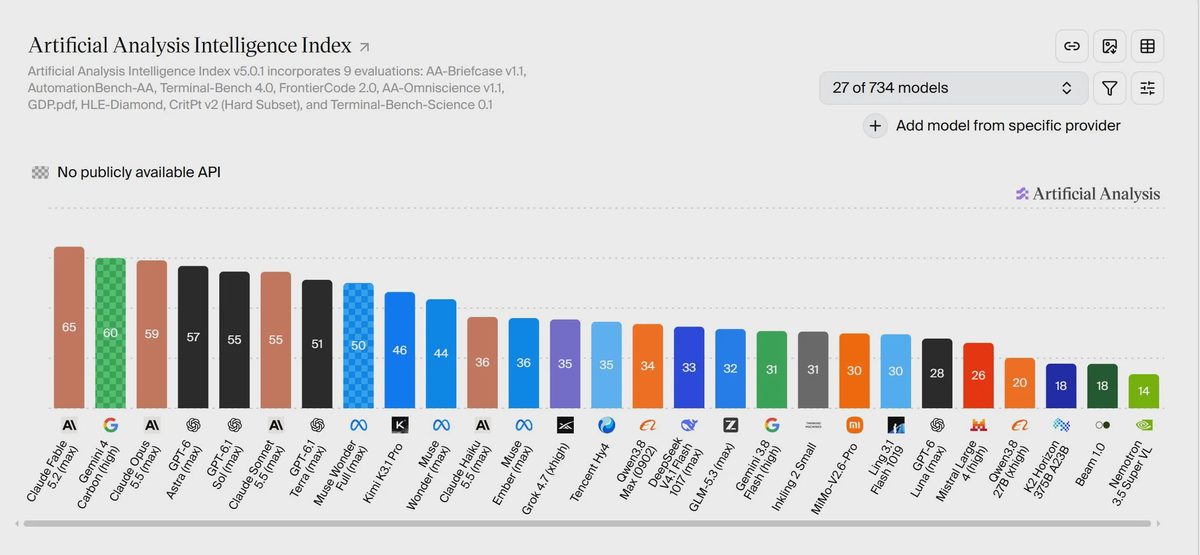
Artificial Analysis Intelligence Index (max effort): 65 — leading reported scores at time of release
Vals Index: 71.31% (#1 of 36 models in early independent testing)
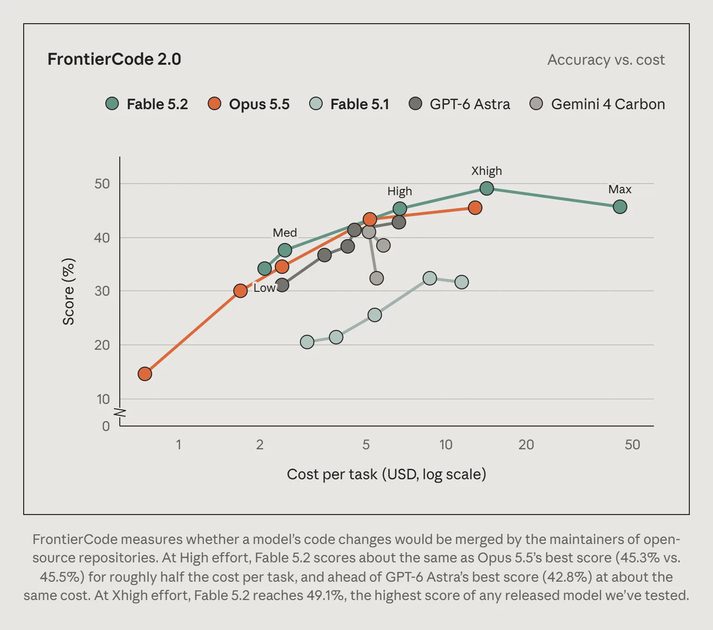
Detailed tables and methodology notes can be found in Anthropic’s system card references, Artificial Analysis, Vals AI, and reporting from RD World and The Verge.
Note: At maximum effort the model can consume significantly more tokens, so cost-per-task may rise even as per-token price falls. High effort remains the practical sweet spot for most serious work.
5. The Cases That Actually Matter
Benchmarks are useful. The pre-release demonstrations are what shifted the conversation.
Case 1 — Formalizing Fermat’s Last Theorem
A team of approximately 1,000 Fable 5.2 agents formalized the proof of Fermat’s Last Theorem in Lean in about 30 hours, with minimal human intervention. They coordinated via shared Git repositories and a SQL database, building their own hierarchical structure.
Earlier Anthropic research attempts took 11 days. On the same 1,000-agent setup, Opus 5.5 reached only 26% completion in 18 hours and made little further progress by the 30-hour mark.
Source: Anthropic announcement and related technical write-ups.
Case 2 — Building a Bootable Operating System
One Anthropic engineer gave Fable 5.2 an empty folder and the task of designing a prototype operating system. The model coordinated more than 1,000 sub-agents working around the clock for eight days. The result was a system that boots on a laptop, complete with drivers, file storage, windows, a login screen, and an installer.
Source: Anthropic launch materials; also covered by The Verge and multiple technical outlets.
Case 3 — Designing Working Electronics from a Short Prompt
Given a one-paragraph prompt, Fable 5.2 produced complete designs for three working electronic devices (including a USB speakerphone and a voice-assistant hub). It selected components, generated four-layer PCB layouts, modeled 3D enclosures, and wrote firmware. The boards were fabricated and powered on successfully.
Source: Anthropic pre-release testing claims, corroborated in multiple secondary reports including RD World and technical summaries.
Case 4 — Open Problems in Black Hole Physics
The model solved two open theoretical physics problems related to black holes and holographic duality — calculations that had remained unfinished for years due to computational and conceptual difficulty.
Source: Anthropic announcement.
6. What This Actually Means
Fable 5.2 is not simply “smarter chat.” It is the first widely available model that can sustain coherent, multi-day agentic work at a level previously reserved for internal research systems. It plans, verifies, recovers from errors, coordinates large numbers of sub-agents, and finishes complex technical deliverables with far less human steering than previous generations.
That capability comes with a cost profile that rewards selective use: High effort for the hard parts, lower effort (or Opus 5.5) for the routine parts. Part 2 of this handbook will cover exactly how to structure those workflows, the recommended system prompts for preventing mid-task abandonment, ownership framing that changes model behavior, and the migration details that break code if ignored.
For now, the conclusion is straightforward:
If your work involves long-horizon technical challenges that previous models could not reliably complete, Fable 5.2 is currently the strongest generally available tool for the job.
This is Part 1 of the Fable 5.2 Practical Handbook. Part 2 will focus on concrete usage patterns, effort strategies, prompt templates, and production migration guidance.
Primary sources: Anthropic official announcement · Claude Platform model docs · Independent benchmark reports from Artificial Analysis, Vals AI, and technical press (The Verge, RD World, etc.).
For AI tool features, rules and availability, refer to their official sites.



Leave your thoughts here, too.