The Problem with "Which One Should I Pick?"
Earlier this year, I asked an AI tool to compare three vendor proposals.
I gave it the details—pricing, delivery timelines, payment terms, warranty coverage. I asked: "Which one should I pick?"
It gave me an answer in about 10 seconds. Vendor B. It ranked the options, explained the reasoning, and told me which one was best.
I almost went with B.
Then I realized something. The AI had picked B because B had the lowest price. That was the only factor it weighted heavily. But the lowest price wasn't the most important factor for us. The vendor with the fastest delivery was more important, because the customer was waiting. The AI didn't know that.
If I had trusted the answer, I would have picked the wrong vendor. Not because the AI was wrong about the facts. Because it was wrong about the priorities.
That's the trap with comparison prompts. The AI will rank, choose, and recommend. It will sound confident. But it doesn't know what matters most to you. That's a judgment call, not a generation task.
So I stopped asking AI to decide. Here are the three prompts I use instead.
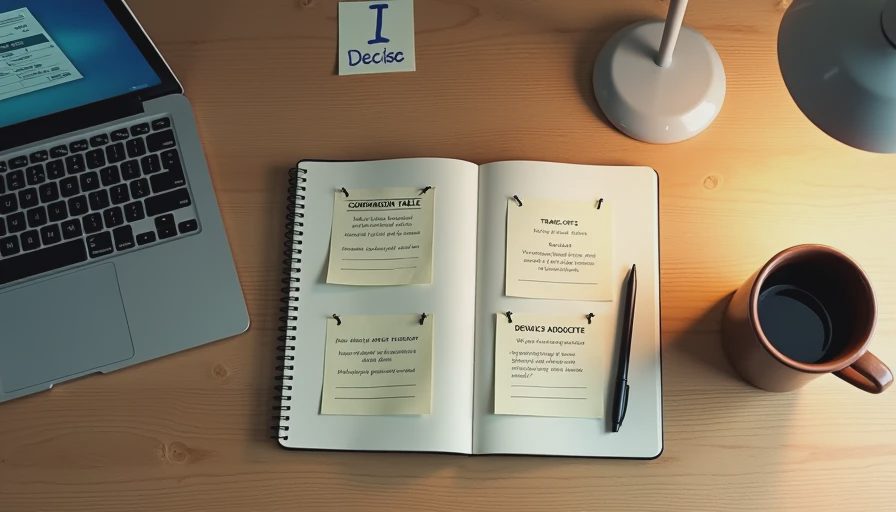
Prompt 1: The Comparison Table
The first prompt doesn't ask for a recommendation. It asks for a structured comparison.
"Here are three options for [decision]. For each option, build a table with the following columns: [list the factors]. Do not rank the options. Do not recommend one. Just fill in the table with the facts I've provided. If a fact is missing, write 'not provided.'"
I use this when I have several options and a defined set of factors. The output is a table. I read it, add my own priorities, and decide.
Why this works: The AI is doing what it's good at—organizing information. It's not doing what it's bad at—judging priorities.
What I still do: I read every cell. The AI sometimes fills in a cell with a plausible guess instead of "not provided." I check each one.
Prompt 2: The Trade-off List
The second prompt asks the AI to name the trade-offs, not pick a winner.
"Here are three options for [decision]. For each pair of options, list the trade-offs. What does Option A give up compared to Option B? What does Option B give up compared to Option C? Do not recommend one option over another. Just name the trade-offs."
I use this when the options are close and the decision is hard. The output is a list of what each option sacrifices. I read it and decide which trade-offs I can live with.
Why this works: Trade-offs are factual. The AI can identify them. Priorities are personal. The AI can't.
What I still do: I confirm every trade-off against the source. The AI sometimes misses a trade-off that isn't obvious from the data. I add those.
Prompt 3: The Devil's Advocate
The third prompt asks the AI to argue against each option.
"Here are three options for [decision]. For each option, write the strongest argument against choosing it. Assume I'm leaning toward that option. What would make me regret it? Do not tell me which option is best. Just tell me what could go wrong with each one."
I use this when I've already started to lean toward one option. The output is a list of risks. I read it and decide whether the risks are acceptable.
Why this works: It forces the AI to argue the opposite of what I'm leaning toward. That's useful because AI tends to agree with the framing it's given. If I say "I'm leaning toward A," the AI will often support A. If I say "argue against A," it will find weaknesses I hadn't considered.
What I still do: I check whether the risks are real. The AI sometimes invents risks. I verify each one.
Why Three Prompts Instead of One
I could combine all three into one prompt. I don't, for two reasons.
Different decisions need different tools. When I'm early in a decision, I use Prompt 1. When I'm closer, I use Prompt 2. When I've almost decided, I use Prompt 3.
Combining prompts produces diluted output. When I ask for a table, trade-offs, and risks in one prompt, the AI does a mediocre job of all three. One prompt, one output.
It keeps me in the loop. Each prompt produces a piece of the decision. I have to assemble the pieces myself. That forces me to think.
A Real Example
Here's how this played out on a real decision.
I was comparing three software tools for our team. All three had similar features. All three had similar pricing. I couldn't decide.
Prompt 1 (Table). I asked for a table comparing the three tools on five factors: price, user count, API access, support tier, and contract flexibility. The output was a clean table. Two cells said "not provided." I went back to the source and filled them in.
Prompt 2 (Trade-offs). I asked for the trade-offs between each pair. The output was a list of 12 trade-offs. Two of them were important. The rest were minor. I noted the two important ones.
Prompt 3 (Devil's advocate). I was leaning toward Tool A. I asked the AI to argue against Tool A. It produced five arguments. Two were real. One was weak. Two were wrong. I checked each one against the source. The two real arguments were enough to change my mind.
I ended up choosing Tool B. The AI never recommended B. It just gave me the pieces I needed to make the decision myself.
Total time: about 40 minutes across three prompts and my own review. My baseline for this kind of decision is about two hours. The AI version was faster, but the speed wasn't the point. The point was that I understood the trade-offs better.

What Still Needed My Attention
Even with three prompts, I still did four things myself.
I read every cell and every line. The AI made small errors in all three prompts. A wrong number in the table. A missing trade-off. An invented risk. I caught them by reading carefully.
I added context the AI didn't have. The AI didn't know that the customer was waiting. It didn't know that one vendor had a history of late deliveries. It didn't know that our team was already trained on one of the tools. I added those.
I made the final call. The AI never recommended. I did. That's the point.
I explained the decision to my manager. The AI couldn't do that. The explanation was mine.
The Limitation
These prompts don't work for every decision.
They work when the options are well-defined and the factors are explicit. They don't work for decisions where the options themselves are unclear. For those, I have to define the options first.
They also don't work when the data is confidential. I redact names and numbers before pasting anything. That adds time and reduces the AI's context.
And they don't replace the final judgment. Even with all three prompts, the decision is still mine. That's not a bug. It's the whole point.
What I've Learned
Three prompts, three outputs, one decision. That's the structure I use now.
The AI is good at organizing facts, naming trade-offs, and arguing the opposite case. It's not good at knowing what matters. If I let it decide, I get an answer that sounds confident and might be wrong.
If I use the AI to gather the pieces and I make the call, I get a decision I understand.
That's worth more than a fast answer.
Test it in real life.
No comments yet.