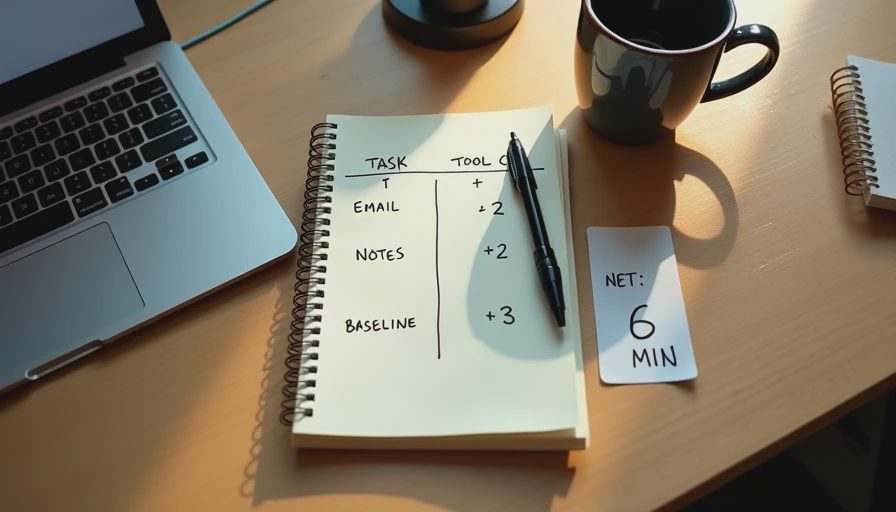
The $3 Question
Most AI tools cost $15 to $30 a month.
That's fine if you use them daily. It's harder to justify if you only need help a few times a week. So when I saw a tool offering a $3 monthly plan, I wanted to test it.
Three dollars is less than a coffee. If it saved me even 10 minutes a week, it would pay for itself. If it didn't, I'd cancel and be out less than a sandwich.
Here's what happened.
What I Tested
Tool: A lightweight AI assistant (I'll call it Tool C)
Price: $3/month after a 7-day trial
Date range: October 1–14, 2026
Tasks tested: Three real work tasks I do every week
My baseline: My existing free AI tool
What I measured: Time saved, correction effort, and whether I kept the subscription
The Three Tasks
I chose three tasks that cover most of my AI use.
Task 1: Email drafting. Write a short follow-up email to a vendor.
Task 2: Meeting notes cleanup. Turn raw notes into a clean summary with action items.
Task 3: Spreadsheet cleanup. Fix formatting and remove duplicates in a 60-row vendor sheet.
The Results
Task 1: Email Drafting
Tool C produced a draft in about 9 seconds. The draft was 130 words. It used the phrase "just checking in" twice, which I had asked it to avoid.
I rewrote the opening, cut one sentence, and removed both "just checking in" instances. That took about 5 minutes.
My free tool usually takes about 3 minutes of editing. So Tool C was slower.
Time saved vs. baseline: Negative 2 minutes.
Verdict: Not useful for email.
Task 2: Meeting Notes Cleanup
Tool C handled this better. I pasted raw notes from a 40-minute operations meeting. It produced a structured summary with decisions and action items.
It missed one action item and misattributed another. But the structure was clean, and the summary was readable. I spent about 7 minutes correcting it.
My free tool takes about 9 minutes for the same task. So Tool C was slightly faster.
Time saved vs. baseline: About 2 minutes.
Verdict: Kept for this task.
Task 3: Spreadsheet Cleanup
Tool C struggled here. I pasted a 60-row spreadsheet. It was supposed to remove duplicates and fix formatting.
It removed 4 duplicates. But 2 of those were not duplicates—they were separate orders with similar vendor names. It also removed the header row, which I had to add back.
Correction time: about 12 minutes.
My free tool handles this in about 6 minutes, with fewer errors.
Time saved vs. baseline: Negative 6 minutes.
Verdict: Not useful for spreadsheet work.

The Numbers
Task | Tool C time | Baseline time | Net time |
|---|---|---|---|
Email drafting | 5 min | 3 min | -2 min |
Meeting notes | 7 min | 9 min | +2 min |
Spreadsheet | 12 min | 6 min | -6 min |
Total for one week of testing: Tool C saved 2 minutes on notes, lost 2 minutes on email, and lost 6 minutes on spreadsheet cleanup.
Net time saved per week: about negative 6 minutes.
That's not good. But the notes task was the one I do most often. If I use Tool C only for notes, I'd save 2 minutes a week. Over a month, that's about 8 minutes.
Eight minutes a month for $3. That's roughly $22 per hour saved. Not a great rate, but not terrible if the tool is reliable.
The problem is that it wasn't reliable. I had to review every output. That's the real cost.
What I Learned
A few things stood out.
Price is not the problem. Reliability is. Three dollars a month is cheap. But if I have to spend 10 minutes fixing errors, the tool isn't saving me anything.
The cheapest tool is not the cheapest option. My free tool does more and makes fewer mistakes. Paying $3 for a worse tool isn't a bargain. It's a downgrade.
One task worked. Meeting notes cleanup was the only task where Tool C beat my baseline. If that were the only thing I used it for, it might be worth $3. But I'd still have to review every output.
I cancelled after two weeks. The net time saved wasn't enough to justify the correction effort. I'd rather use my free tool and spend the saved $3 on coffee.
The Verdict
Cancelled.
Tool C is not a bad tool. It's just not better than what I already have. At $3 a month, it's cheap enough that I almost kept it for the notes task alone. But I already have a free tool that does notes almost as well, with fewer errors.
If Tool C improves, I might try it again. For now, I'm out.
Baseline note: My baseline was my existing free AI tool. Tool C lost on two of three tasks and only won on one by 2 minutes. The $3 subscription didn't earn its place.
The Limitation
This test used three tasks in two weeks.
A different mix of tasks might change the result. A heavier notes workload might make Tool C worth it. A lighter workload might make it useless.
Also, I only tested one price tier. The paid tiers of other tools might offer better accuracy at a similar price. I haven't tested those yet.
And I didn't test with different data types. My spreadsheet was clean. A messier spreadsheet might produce worse results from Tool C or from my baseline.
Test it in real life.
No comments yet.